
The Benchmarks: A Tale of Two Triumphs
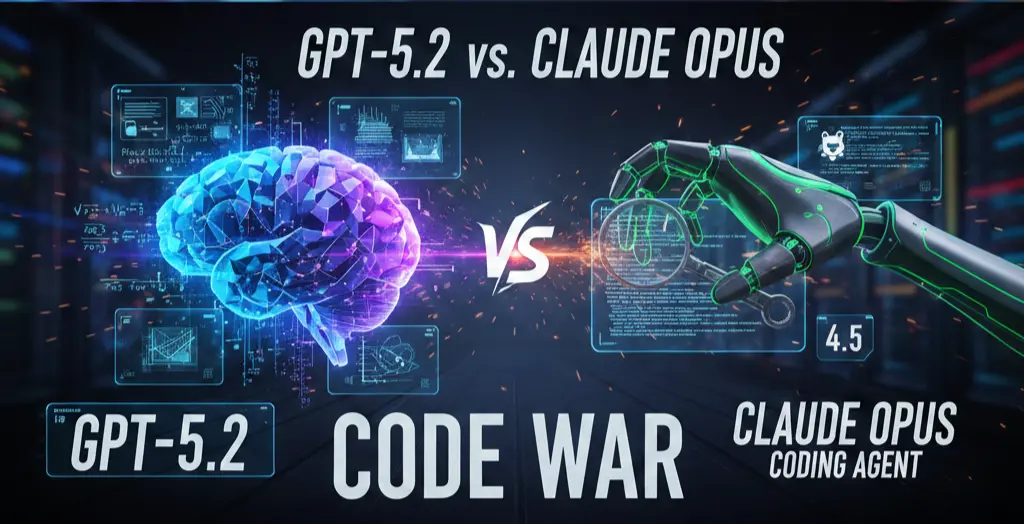
You can’t talk about LLMs without mentioning benchmarks, even if they don't capture everything. What's interesting here is that each model claims victory in a slightly different domain, which actually points to their core strengths.
Claude Opus: The Real-World Fixer
If you look at the SWE-Bench Verified scores, which uses real GitHub issues to test a model's ability to fix bugs and apply patches, Opus 4.5 is still, just barely, ahead. We're talking something like 80.9% for Opus versus 80.0% for GPT-5.2. That's a tiny margin, I know, but it tells you something.
Claude Opus feels like it has a deeper, more inherent understanding of what a software project actually is. It’s built for that sustained, multi-file reasoning, which is exactly what fixing a complex GitHub issue requires. It's often more token-efficient too, meaning it can achieve the same result in fewer steps and with less "fluff," which is great when you’re paying by the token.
GPT-5.2: The Abstract Problem Solver
Where GPT-5.2 really shines, and where its new 'intelligence upgrade' is undeniable, is in pure, abstract reasoning and mathematics. The benchmark scores for things like ARC-AGI-2 (abstract reasoning) and the AIME 2025 math contest show GPT-5.2 significantly outperforming Opus.
Why does this matter for a coder? Because complex software engineering isn't just about reading code; it’s about novel problem-solving. If you're tackling a brand-new architectural design, figuring out an esoteric algorithm, or working in a highly specialized, logic-heavy domain (like advanced data science or cryptography), GPT-5.2's raw brainpower often gives it the edge.
Agentic Workflows: Delegation vs. Deep Dive
This is where the rubber meets the road. We’re moving beyond simple "write this function" prompts into agentic workflows, where the AI is expected to manage a multi-step task, use tools (like a code interpreter or a search engine), and correct its own errors.
The Agentic Edge: GPT-5.2's Orchestration
OpenAI has clearly focused on making GPT-5.2 a master orchestrator. I’ve found it more reliable at:
- Multi-Step Tool Use: It's better at planning a complex sequence of steps, Search, then Code, then Run, then Refactor, without getting lost or stuck in an infinite loop.
- Structured Output: For non-code developer tasks, like generating a clear, formatted
YAMLconfiguration or an accompanying technical spec and the code, GPT-5.2 is incredibly consistent. It's built for those structured, enterprise-level outputs. - Ecosystem Integration: Honestly, the sheer size of the ChatGPT ecosystem means GPT-5.2 works seamlessly with countless IDE plugins and third-party tools.

The Coding Agent: Claude Opus's Reliability
But here's a personal observation: while GPT-5.2 is a better orchestrator of agents, Claude Opus feels like a better dedicated coding agent. Users are consistently reporting that when given a complex, multi-file refactoring or bug-fixing task, Opus gets to a working solution in fewer overall attempts.
It seems to have a stronger internal loop for self-correction in a coding context. I'd almost say:
GPT-5.2 is better at planning the whole project; Claude Opus is better at executing the deep code changes.
Plus, Opus is still the safety-first choice, leveraging Anthropic’s Constitutional AI for more predictable and robust behavior, especially when integrating into high-stakes, internal enterprise systems.
The Verdict: Which One Should You Choose?
Like all things in AI, there is no single "winner." It completely depends on what you're doing.
For my day-to-day work, I’ve found myself leaning towards GPT-5.2 for high-level design and complex mathematical logic, and switching to Claude Opus when I need to jump into a huge, messy codebase for a bug fix or a significant refactor. You might find yourself doing the same.
Ultimately, both models are a marvel, pushing the capabilities of AI assistance beyond simple autocomplete. The competition is fierce, and for us developers, that's the best news possible.
Also have look at a overall cpmparison between GPT-5.2 with Gemini 3.
Inspire Others – Share Now
Agentic AI Saksham
India’s Only 1st Ever Offline Hands-on program that adds 4 Global Certificates while making you a real engineer who has built their own AI Agents
EV
Saksham
India’s Only 1st Ever Offline Hands-on program that adds 4 Global Certificates while making you a real engineer who has built their own vehicle
Agentic AI LeadCamp
From AI User to AI Agent Builder — Capabl empowers non-coding professionals to ride the AI wave in just 4 days.
Agentic AI MasterCamp
A complete deployment ready program for Developers, Freelancers & Product Managers to be Agentic AI professionals