
The Core Intelligence: Reasoning and Reliability
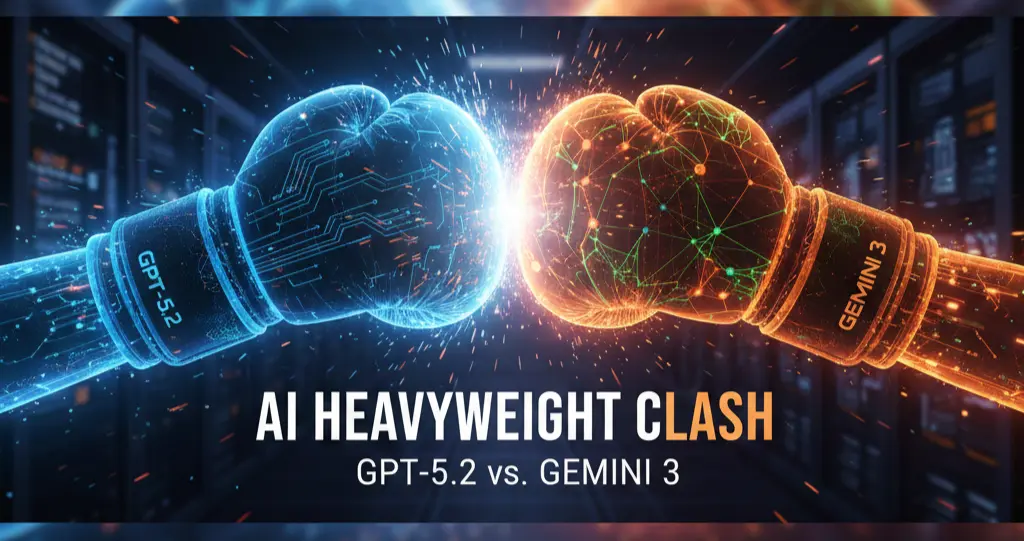
This is where the rubber meets the road. Both companies are claiming superior intelligence, but they seem to be focusing on slightly different definitions of "smart."
- GPT-5.2: The Dependable Professional.OpenAI has clearly doubled down on making GPT-5.2 the precision tool. It's all about structured, reliable output for professional work. When you're making a financial spreadsheet, writing a long-form legal brief, or debugging a multi-file codebase, you need fewer mistakes and more factual consistency. Early reports suggest GPT-5.2 is nailing this. They claim significant wins on benchmarks for "professional knowledge work," and the internal testing suggests a noticeable drop in hallucination-like errors (something we all despise, right?). It’s the reliable teammate you trust not to mess up the final presentation.
- Gemini 3: The Deep Theoretical Thinker.Gemini 3, especially its "Deep Think" variants, is pushing the boundaries on abstract and scientific reasoning. When the problem requires pure, unadulterated intelligence, like solving complex math problems without external tools or grappling with abstract logic puzzles (think the ARC-AGI benchmarks), Gemini 3 often edges ahead. It’s like the brilliant but slightly eccentric professor who can solve the universe’s problems but might not remember to organize their desk. It prioritizes the depth of its internal reasoning tree.
My quick take? If your job is structured, multi-step execution (like a business analyst or a developer), GPT-5.2 seems more reliable. If your work is pure, deep research or complex problem-solving in a scientific field, Gemini 3 might give you that extra theoretical edge.
Coding and Developer Workflows
This is a huge battleground, because developers are the ones building the next generation of AI-powered tools.
For a while, Gemini 3 looked like it was taking the crown, but OpenAI responded with some impressive gains in GPT-5.2.
GPT-5.2 takes a slight overall lead here. Its focus on structured execution and high reliability in multi-step coding projects makes it a more dependable partner for real-world software engineering. Developers need the model to reliably debug and refactor large codebases, and that seems to be where GPT-5.2 shines.
The Multimodal Frontier and Context Size
Multimodality (the ability to handle text, images, video, and audio simultaneously) was Gemini's initial big claim to fame. And it still holds an advantage, to be frank.
- Gemini 3's Multimodal Strength: Google's model has a unified architecture that makes its comprehension of mixed inputs incredibly smooth. If you’re analyzing video, understanding charts in a document, or dealing with a complex mix of visual and text data, Gemini 3 remains the powerhouse.
- GPT-5.2's Focus: While GPT-5.2 has strong multimodal features, especially in interpreting scientific diagrams and visual data for knowledge work, it still seems to be playing catch-up to Gemini's breadth in creative and general visual understanding.
- The Context Window: This is all about memory. Can the model remember everything we’ve said?
- Gemini 3 Pro has the headline-grabbing number: a massive, up to 1 Million (1M) token context window. You can literally drop an entire book or a huge codebase into the prompt.
- GPT-5.2 focuses on reliability within a still-very-large 256K token context. OpenAI argues that simply having a bigger window doesn't matter if the model "loses track" of key facts inside it, which is called the "lost-in-the-middle" problem. They claim their architecture is better at utilizing the context it has, making it more stable for long conversations.
My personal observation? For daily use, you rarely hit that 256K limit, so GPT-5.2's reliability is likely more valuable. But for the power user who needs to ingest multiple massive legal documents or a massive code repository, Gemini 3's raw 1M capacity is a game-changer.

Price and Ecosystem: The Practical Decision
This isn't just a technical battle; it's an ecosystem war, and your choice might just come down to where you spend your workday.
This is a case of choose your home base. If your company runs on Microsoft Teams, Azure, and your desktop uses ChatGPT every hour, GPT-5.2 slots right in. If your organization is deep in Google Workspace, uses Google Cloud, and relies heavily on search integration, Gemini 3 is a no-brainer. The integration advantage is almost impossible to overcome purely on model performance.
Final Verdict: Which One Should You Use?
Honestly, the gap has never been smaller. We are in a golden age of LLMs, and these two models are pushing each other to insane new heights. The "Code Red" at OpenAI after the Gemini 3 launch really tells you everything you need to know about the intensity of this competition.
- Go with GPT-5.2 if: You need reliability and precision for high-stakes professional work: coding, complex multi-step planning, high-quality documentation, and structured deliverables like spreadsheets and presentations. It's the stable, enterprise workhorse.
- Go with Gemini 3 if: You need massive context capacity (1M tokens), superior multimodal capabilities (especially for video and creative work), or if your entire workflow is built on the Google ecosystem. It’s the frontier AI pushing scale and theoretical depth.
To get a detailed comparison with gpt-5.2 with gpt-5 and gpt-4o. Click here.
Inspire Others – Share Now
Agentic AI Saksham
India’s Only 1st Ever Offline Hands-on program that adds 4 Global Certificates while making you a real engineer who has built their own AI Agents
EV
Saksham
India’s Only 1st Ever Offline Hands-on program that adds 4 Global Certificates while making you a real engineer who has built their own vehicle
Agentic AI LeadCamp
From AI User to AI Agent Builder — Capabl empowers non-coding professionals to ride the AI wave in just 4 days.
Agentic AI MasterCamp
A complete deployment ready program for Developers, Freelancers & Product Managers to be Agentic AI professionals