
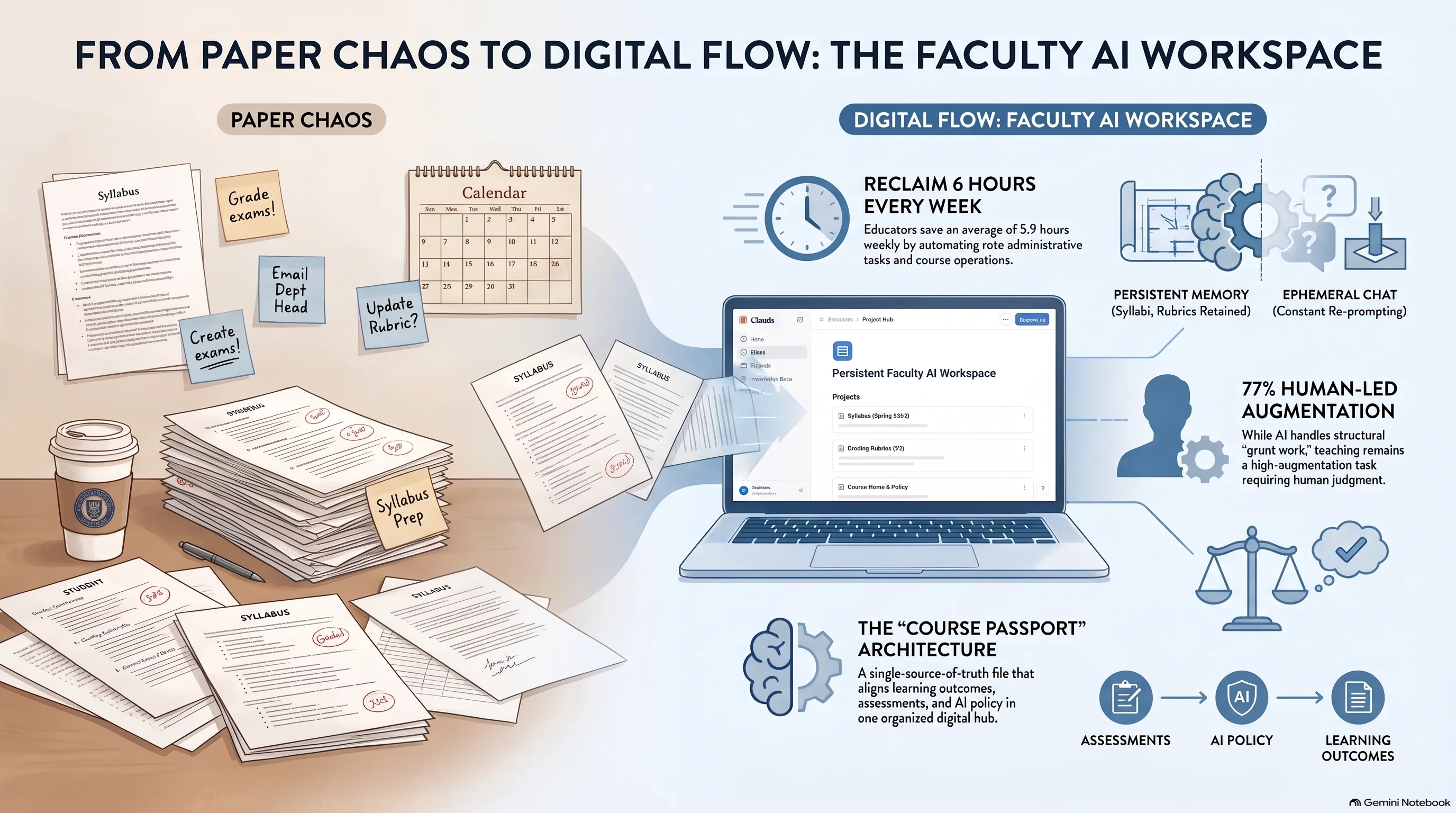
The Quick Summary: Indian professors spend 14-20 hours a week in classrooms and labs, and another 12-16 hours managing Course Files, attendance shortage lists, Bloom’s question moderation, and NBA/NAAC paperwork. Generic AI chatbots fail because of "session amnesia." This guide breaks down the operational blueprint for building a Persistent Course Workspace (Digital Course File) that automates routine academic drafting while keeping faculty in complete evaluative control.
The Hard Truth About AI in Higher Education
Ask almost any engineering or science professor in India about their experience with ChatGPT or Claude, and you will hear a variation of the same story:
\"I asked it to create an internal test question paper for Database Management Systems. It gave me 5 generic questions about what a database is. None of them matched our university syllabus, none of them had the required Bloom’s taxonomy marks distribution, and it took me longer to fix the output than to write the paper myself.\"
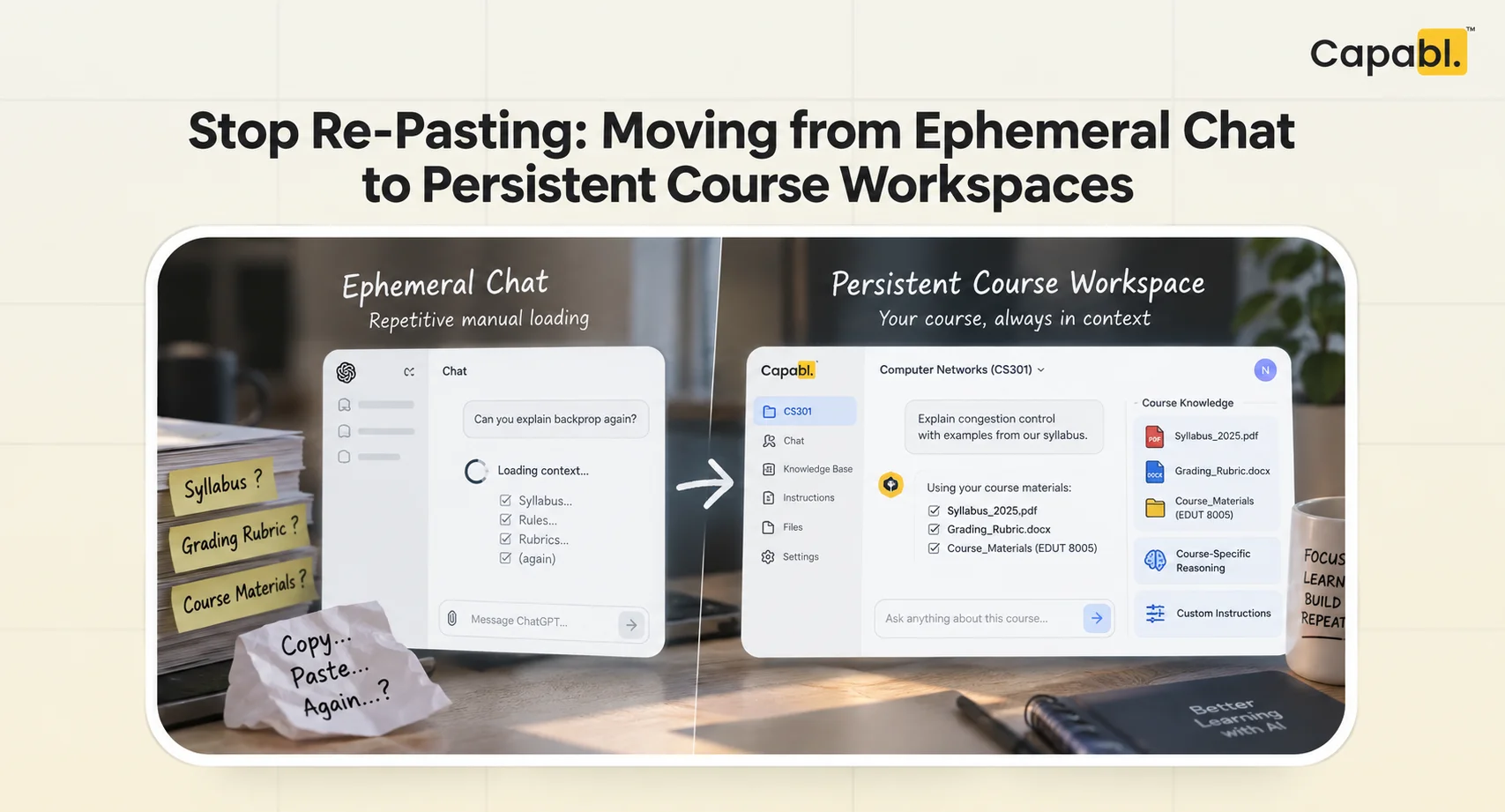
This is the Ephemeral Chat Trap.
Every time you open a blank chat window, the AI has total amnesia. It has no idea about your university’s autonomous credit scheme, your approved Course Outcomes (COs), your 15-week academic calendar, or the fact that 30% of your classroom is transitioning from regional-language schooling to technical English.
When you treat AI like a disposable search bar or a standalone tool, it behaves like an uncalibrated intern. But when you anchor it inside a Persistent Course Workspace, it becomes a formidable institutional force-multiplier.
The Indian Faculty Reality: The \"Triple Burden\"
In Western universities, professors often rely on teaching assistants, administrative secretaries, and dedicated grading teams. In India, an educator manages the entire academic lifecycle end-to-end.
On any given week, a faculty member balances three competing demands:
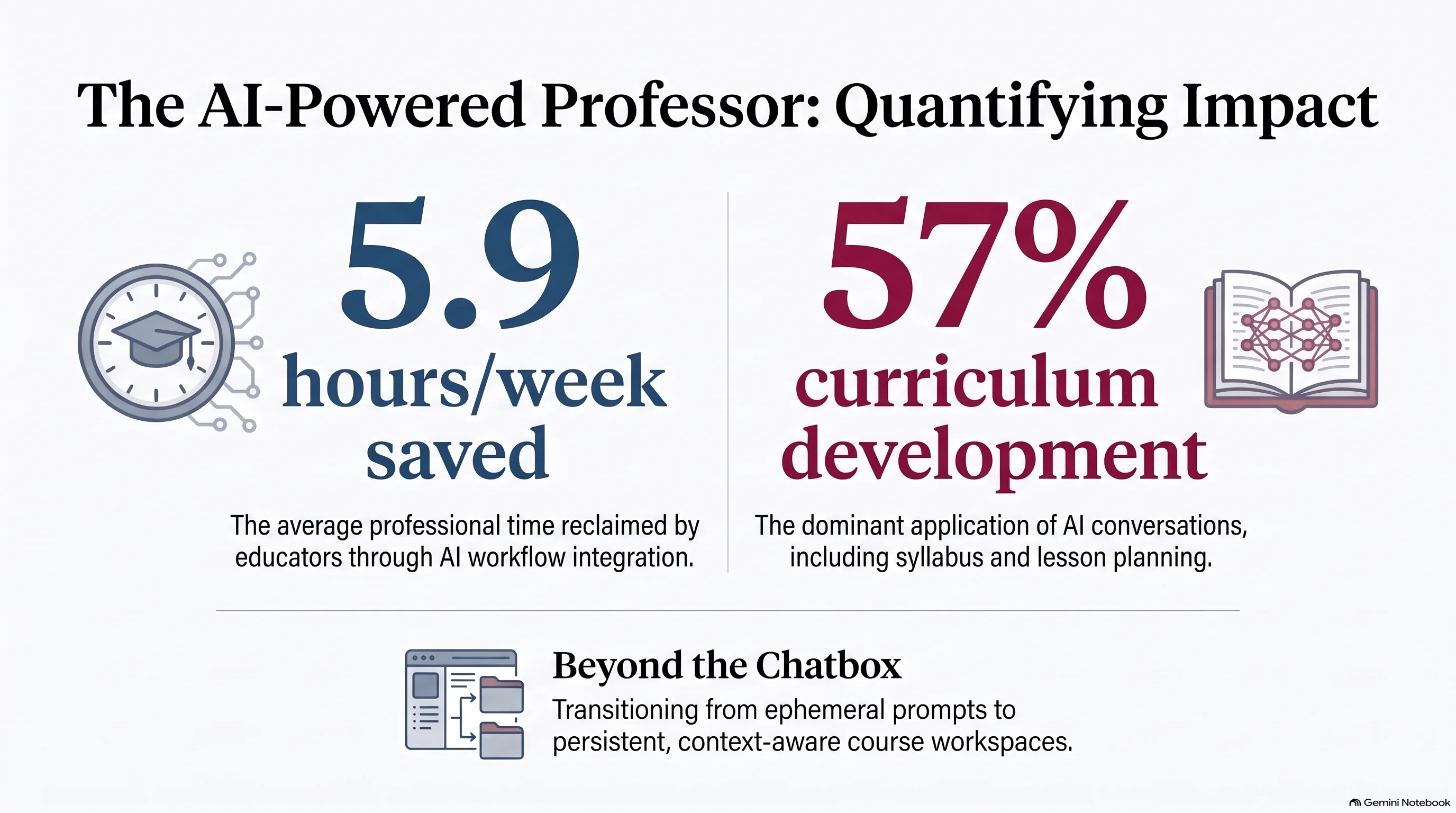
- Direct Instruction (14-20 Contact Hours / Week): Delivering theory lectures, tutorials, and 3-hour practical lab sessions across heterogeneous divisions of 60-75 students.
- Continuous Assessment & Evaluation: Setting Continuous Internal Evaluation (CIE) test papers mapped strictly to CO1-CO5, formulating granular Schemes of Evaluation with step-by-step marks, and grading hundreds of answer scripts under tight 5-day university audit deadlines.
- Academic Administration & Statutory Accreditation (12-16 Hours / Week): Maintaining physical Course Files, tracking attendance defaulters (< 75%), logging mentor-mentee counseling registers, and calculating CO-PO Direct Attainment matrices for NBA SAR and NAAC AQAR filings.
The result? Cognitive fatigue. Professors spend their best creative energy on mechanical documentation rather than mentoring students, conducting research, or designing transformative classroom experiences.
The Core Shift: From Ephemeral Chat to the \"Digital Course File\" Workspace
The fundamental breakthrough is simple: Stop starting from scratch in every chat session.
Using Claude Projects, faculty can build a dedicated, persistent Digital Course Workspace for every subject they teach. This workspace acts as a digital twin of your accredited Course File.
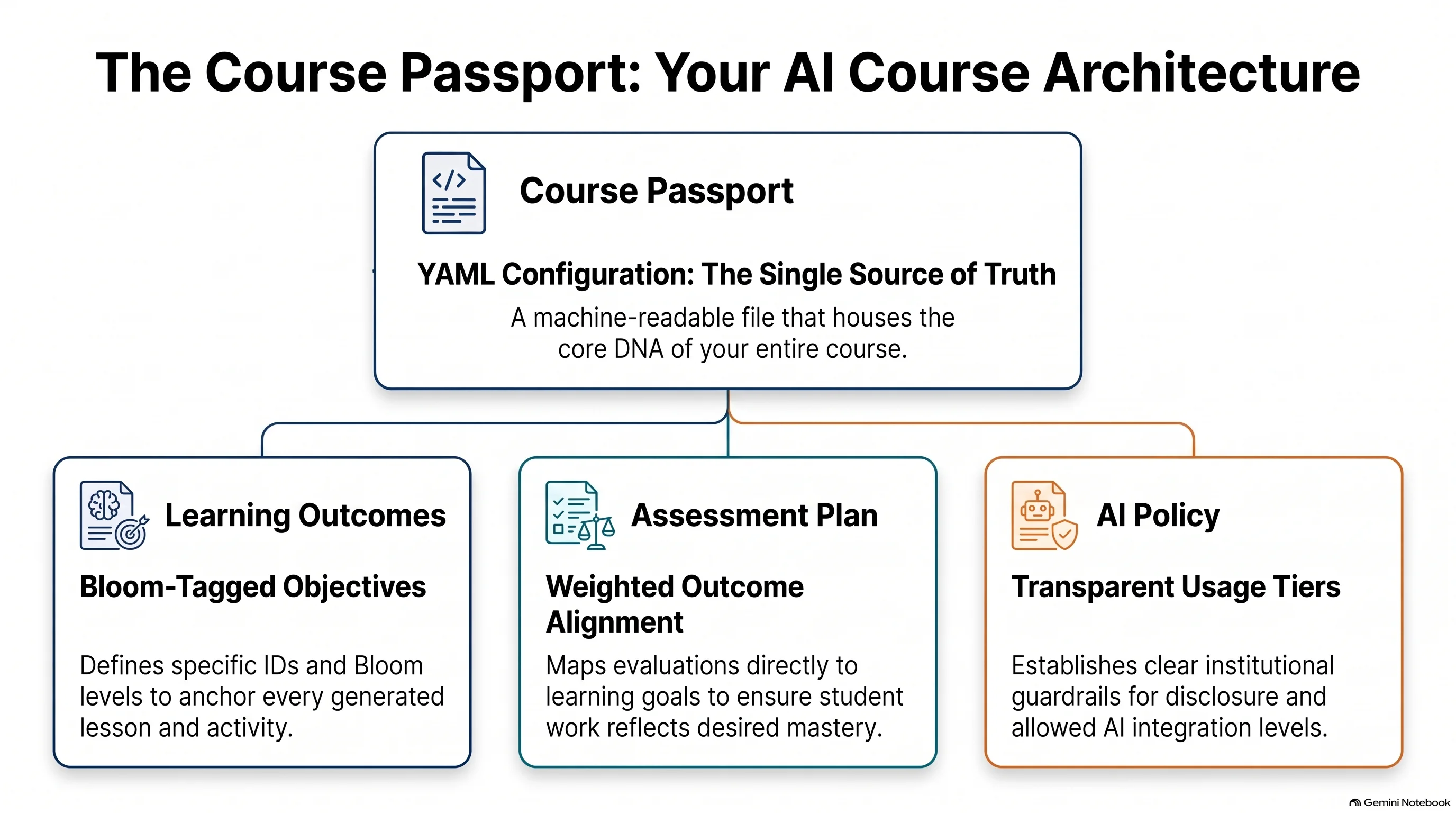
A complete workspace pairs two synchronized institutional layers:
- Project Knowledge Base (Uploaded once at semester start):
- Approved University Syllabus & Reference Textbook List
- Institutional Academic Calendar (Semester Working Days)
- Approved Course Outcomes (CO1 to CO5) & Bloom Cognitive Levels
- CO-PO & CO-PSO Articulation Matrix
- Standard Question Paper Template & Evaluation Scheme Format
- Project Custom Instructions (Permanent institutional rules):
- Autonomous Scheme & Credit Framework (e.g., 3:0:2, 4 Credits)
- Student Profile (Vernacular transition scaffolding, batch size)
- Regulatory Guardrails (NEP 2020 OBE, Bloom Tagging, DPDP Act 2023)
Once anchored, the AI retains permanent institutional memory of your course. Every prompt you execute throughout the 15-week semester automatically enforces your Course Outcomes, Bloom cognitive levels, and university formatting rules.
4 Practical Transformations You Can Run Tomorrow
Here is how persistent course workspaces transform everyday faculty workflows:
1. Bloom-Calibrated Question Papers & Schemes of Evaluation in Minutes
Under the AICTE Examination Reforms Policy and NBA SAR Criteria 2, internal test papers must avoid over-indexing on rote recall (with AICTE recommending that lower-order knowledge questions not exceed 40%). A balanced Outcome-Based Education (OBE) balance for a 50-mark CIE test includes:
- Part A (Foundational / L1-L2 - 30% / 15 Marks): Core definitions, block diagrams, and fundamental derivations.
- Part B (Core Engineering / L3-L4 - 50% / 25 Marks): Applied problem-solving, algorithmic tracing, and analytical proofs with internal choice (
OR). - Part C (Advanced HOTS / L5-L6 - 20% / 10 Marks): Design challenges, multi-variable trade-off evaluations, and open system optimization.
The Workspace Prompt:
Draft CIE Test 1 (50 Marks, 90 Minutes) covering Unit 1 and Unit 2:
- Follow the autonomous question paper template in the knowledge base.
- Target CO1 (L4) and CO2 (L3) with strict 30/50/20 Bloom distribution.
- Include explicit tags for Question No., CO, Bloom Level, and Marks.
- Generate a complete, step-by-step Scheme of Evaluation detailing
  partial marks allocation for formulas, intermediate steps, and
  final numerical values.
The Output: A fully moderated question paper and an audit-ready Scheme of Evaluation ready for departmental moderation in under 3 minutes.
2. Differentiated & Multilingual Pedagogy (NEP 2020)
Indian classrooms are linguistically diverse. A common challenge in tier-2 and tier-3 colleges is that students possess strong logical intuition but struggle with dense English academic terminology.
The Bilingual Concept Bridge
Your course workspace generates localized, culturally resonant technical analogies (e.g., explaining database deadlocks through single-track railway crossings or pointer dereferencing through postal addresses) that ground intuition before diving into complex mathematical formalisms.
3-Tier Problem Sets
Instead of a one-size-fits-all homework assignment that frustrates struggling students while boring top performers, prompt your workspace for a 3-tier distribution:
- Tier 1 (Foundation - 40%): Direct formula application and concept recall for prerequisite reinforcement.
- Tier 2 (Core Application - 40%): Multi-step engineering analysis and debugging scenarios.
- Tier 3 (HOTS / GATE-Level - 20%): Open-ended competitive exam challenges for advanced learners.
3. Zero-Friction Academic Administration
Beyond teaching, professors spend hours each week drafting notices, checking registers, and compiling meeting minutes:
- Attendance Defaulter Lists: Paste raw attendance percentages; Claude flags < 75% defaulters, generates formal HoD notices, and drafts bilingual parent intimation letters.
- Board of Studies (BOS) Minutes: Paste raw discussion points; Claude outputs formal Minutes of Meeting (MoM) and an accompanying Action Taken Report (ATR) table with designated faculty leads.
- Mentor-Mentee Counseling Logs: Structure informal counseling notes into auditable proctorial records aligned with NAAC Key Indicator 2.3.
4. Continuous Quality Improvement (CQI) & NBA/NAAC Attainment
During accreditation visits (NBA Peer Teams or NAAC Assessors), the most critical question asked of faculty is:
\"What was your Course Outcome attainment gap, and what concrete remedial actions did you take to fix it?\"
Using your course workspace:
- Paste Anonymized Test Marks: Claude calculates the percentage of students achieving the target threshold for each CO (Level 3: ≥ 70%, Level 2: 60-69%, Level 1: 50-59%).
- Diagnose Lagging Outcomes: If CO4 attainment drops to 52%, Claude identifies the specific sub-topics causing student failure.
- Formulate the Action Taken Report (ATR): It drafts auditable curriculum interventions (e.g., dedicated weekend tutorial hours, hands-on simulation modules) ready for immediate insertion into your Course File.
Two Non-Negotiable Boundaries: Data Privacy & Faculty Authority
As educators embrace AI, two non-negotiable boundaries must be upheld:
1. Compliance with the DPDP Act, 2023
Under India’s Digital Personal Data Protection Act (DPDP 2023), institutions are legally obligated to protect student personal data:
- Never paste Personally Identifiable Information (PII): Strip student names, University Seat Numbers (USNs), roll numbers, phone numbers, and email addresses before processing mark sheets or attendance registers.
- Keep Examination Papers Offline: Never upload unreleased university semester-end examination papers to any cloud service.
2. The Non-Delegable Evaluation Mandate
Under Indian university statutes, evaluative authority cannot be delegated to an algorithm. AI serves as an exceptional drafting engine and diagnostic assistant. However:
- The faculty member alone awards marks and assigns final grades.
- The faculty member alone verifies the mathematical correctness of evaluation keys.
- The faculty member alone signs official institutional documentation.
How to Get Started in 15 Minutes
You do not need an enterprise contract or coding skills to start building your persistent course workspace today:
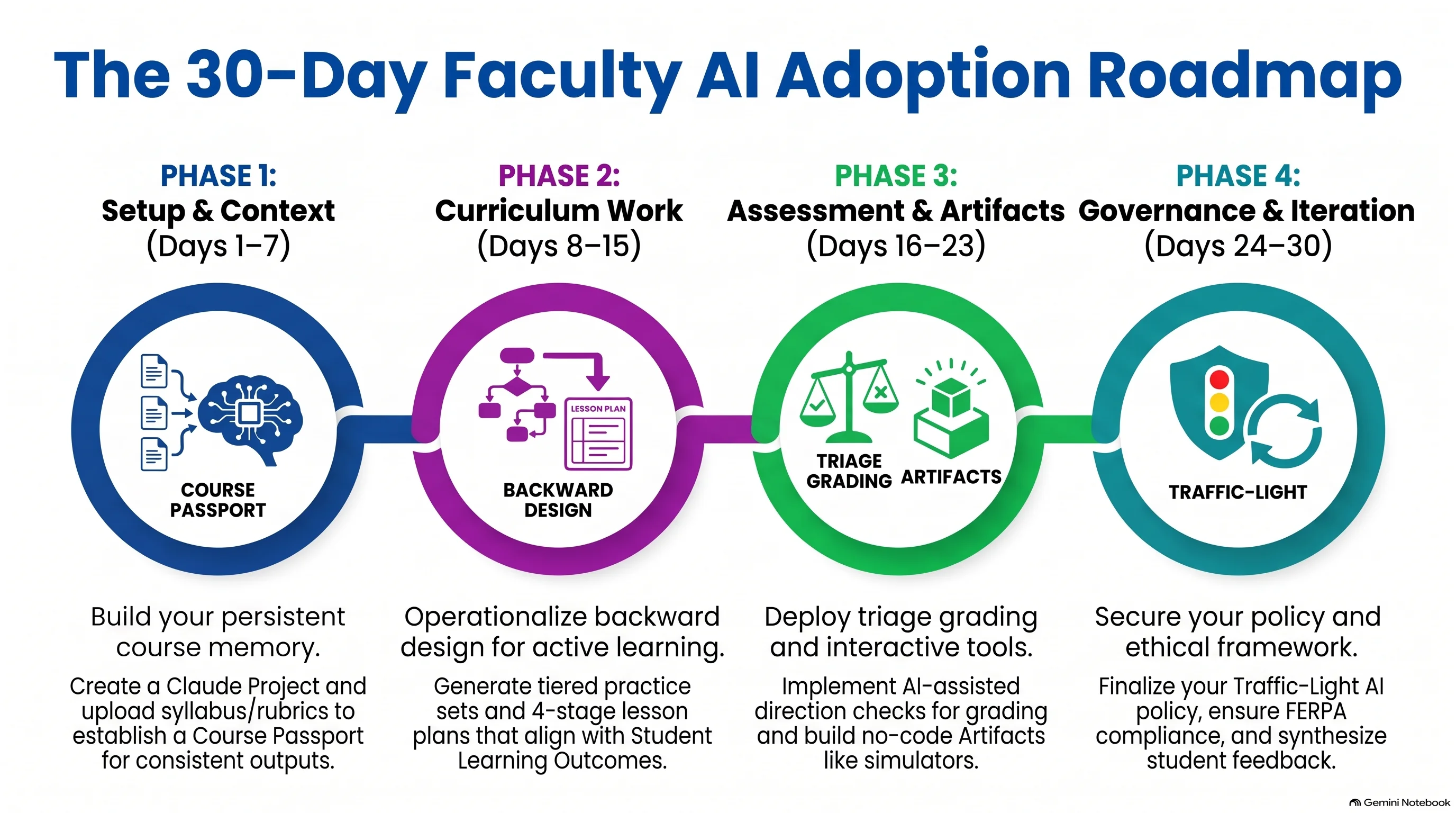
- Create Your Course Project (2 mins): Open Claude (
claude.ai), navigate to Projects, and create a project named[Course Code] - [Subject Name] - 2026-27. - Upload Your Course Foundation (5 mins): Upload your university syllabus PDF, academic calendar, and approved Course Outcomes.
- Set Project Custom Instructions (3 mins): Paste your institution’s grading scheme, class profile, and OBE constraints into the instructions box.
- Run Your First Transformation (5 mins): Prompt your workspace: \"Generate a 15-week lecture plan mapped to COs with Teaching-Learning Methods (TLM) from the uploaded syllabus.\"
The Bottom Line
AI will not replace the passionate Indian professor. But professors who anchor their courses in persistent course workspaces will replace the burnout, paper chaos, and late-night accreditation panic with structured, high-impact teaching.
It is time to move beyond the chatbox, and start building.
Inspire Others – Share Now
Agentic AI Saksham
India’s Only 1st Ever Offline Hands-on program that adds 4 Global Certificates while making you a real engineer who has built their own AI Agents
EV
Saksham
India’s Only 1st Ever Offline Hands-on program that adds 4 Global Certificates while making you a real engineer who has built their own vehicle
Agentic AI LeadCamp
From AI User to AI Agent Builder — Capabl empowers non-coding professionals to ride the AI wave in just 4 days.
Agentic AI MasterCamp
A complete deployment ready program for Developers, Freelancers & Product Managers to be Agentic AI professionals
Table of Contents
- 1. Bloom-Calibrated Question Papers & Schemes of Evaluation
- 2. Differentiated & Multilingual Pedagogy (NEP 2020)
- 3. Zero-Friction Academic Administration
- 4. Continuous Quality Improvement (CQI) & NBA/NAAC Attainment
- 1. Compliance with the DPDP Act, 2023
- 2. The Non-Delegable Evaluation Mandate