
1. The Quick Version
The article establishes the main differences:
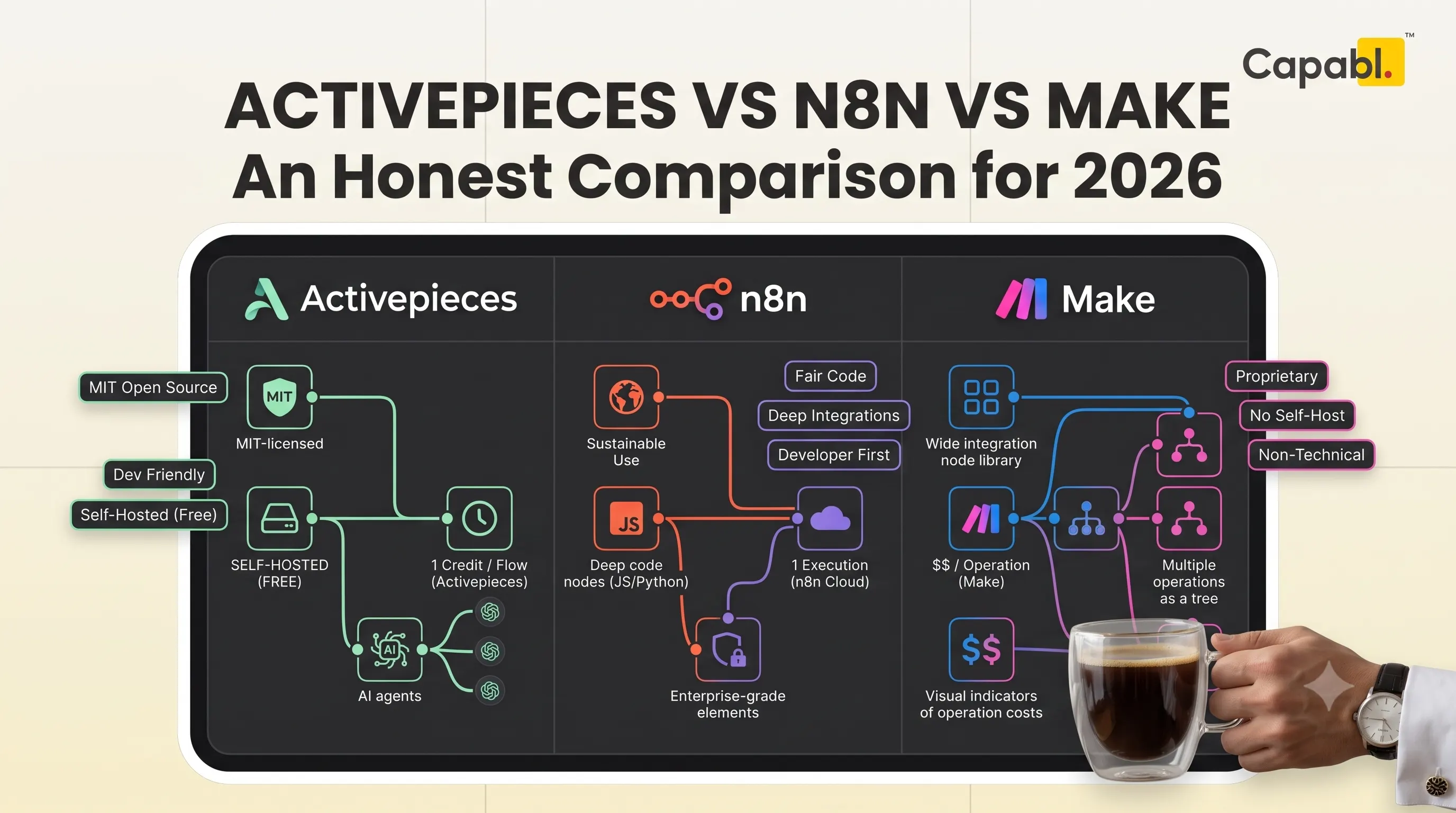
- Activepieces: MIT-licensed, self-hostable, credit-based pricing, 300+ integrations, strongest emphasis on AI agents.
- n8n: Fair-code, self-hostable, execution-based pricing on cloud, 500+ nodes, strongest developer experience and control.
- Make: Proprietary cloud platform, 1,800+ integrations, highly visual interface, strongest for non-technical teams.
2. Pricing
The pricing models fundamentally affect how workflows are designed.
- Make charges per operation, so complex workflows can become expensive.
- n8n Cloud charges per execution, while self-hosted n8n is free.
- Activepieces uses credits, with a flow costing one credit regardless of its number of steps, while AI operations consume additional credits.
- On the free tier, Activepieces does not allow you to bring your own AI provider key. AI steps use Activepieces' own AI credits/providers, rather than letting you connect your own API key.
- Self-hosted Activepieces is free under its MIT license.
- For simple, low-volume workflows, Make can be cheaper, while complex or high-volume workflows generally favor n8n or Activepieces.
3. Integrations
The comparison is essentially breadth vs depth.
- Make has 1,800+ integrations, making it the strongest choice for obscure SaaS applications.
- n8n has 500+ nodes, but its integrations tend to expose more API functionality and edge cases.
- Activepieces has 300+ pieces and is rapidly expanding, although some integrations still lack the depth of n8n.
- Overall: Make wins on breadth, n8n on depth, and Activepieces is the fastest-growing challenger.
4. Self-Hosting
- Make: No self-hosting.
- n8n: Self-hosting is free, but its Sustainable Use License restricts offering n8n itself as a hosted service.
- Activepieces: MIT licensed, allowing users to self-host, modify, embed, and sell access.
- Both n8n and Activepieces work well with Docker, although n8n has more mature deployment documentation and community support.
5. Performance
The blog compares available load-testing results.
- n8n handled roughly 220 executions/second in cited 2024 testing.
- Activepieces initially performed considerably slower because of process-per-task isolation.
- Its later unsandboxed mode reportedly produced roughly a 50× improvement in tested scenarios.
- Make is harder to benchmark independently because it is fully cloud-managed.
- For ordinary business automation, performance differences are generally negligible.
6. Developer Experience
- n8n: Powerful and developer-oriented, but comparatively complex.
- Activepieces: Cleaner and easier to learn, with somewhat less power for complicated transformations.
- Make: The most visually intuitive, with a polished canvas-based editor, but its proprietary formula system is less transferable.
7. Code Control
- n8n provides JavaScript and Python code nodes.
- Activepieces provides JavaScript/TypeScript code pieces.
- Make provides considerably more limited custom-code capabilities.
- Both n8n and Activepieces allow workflows to be exported as JSON, making it possible to keep workflow definitions outside the platform and move or version them more easily.
8. Error Handling and Debugging
- n8n has dedicated error workflows, retry mechanisms, execution history, and replay capabilities.
- Activepieces provides failure triggers and execution logs, but the tooling is newer.
- Make provides visual execution results and module-level error handlers, although complicated branching can be harder to debug.
9. AI Integration
The article identifies AI as a major differentiator in 2025–2026.
- Activepieces built native multi-agent capabilities, including LLM orchestration and memory.
- n8n integrates AI agents, LangChain, and memory into its composable workflow system.
- Make supports AI models but was not originally designed around agentic workflows, making more complex agent loops and memory use cases less natural.
10. When Each One Makes Sense
Activepieces is recommended for:
- Credit-based pricing
- True MIT-licensed software
- Semi-technical teams
- AI-agent workflows
- Cost-conscious startups
n8n is recommended for:
- Developers
- High-throughput automation
- Complex transformations
- Deep integrations
- Enterprise reliability
- Large communities and extensive tutorials
Make is recommended for:
- Non-technical teams
- Broad SaaS integration requirements
- Low-volume workflows
- Fast visual automation
- Marketing agencies
The article also recommends not migrating if the existing Make setup costs under $30/month, is stable, has only a handful of scenarios, or depends on a Make-exclusive integration.
11. Who's Actually Using These Tools
The article compares customer adoption.
- Activepieces: Companies such as PostHog, Red Bull, Rakuten, Roblox, DocuSign, Pipedrive, and MoneyGram are listed.
- n8n: Microsoft, Meta, NVIDIA, Dell, Mercedes-Benz, Vodafone, Deutsche Telekom, Mistral AI, and others are listed, alongside several quantified case studies.
- Make: Customers include BNY Mellon, Stellantis, Globant, Bolt, BambooHR, and others, with published success stories involving savings and efficiency improvements.
The article's conclusion here is that n8n has the strongest enterprise proof points, Activepieces has impressive but less detailed customer evidence, and Make is particularly strong among agencies and mid-market teams.
12. n8n Cloud vs Hostinger VPS
The blog compares managed n8n Cloud with self-hosted n8n.
- n8n Cloud starts at around €20/month for 2,500 executions.
- Higher plans increase execution limits and concurrency.
- Hostinger VPS plans start considerably cheaper and provide unlimited n8n executions.
- The trade-off is that self-hosting requires handling updates, backups, SSL, security, and server maintenance yourself.
The article argues that once you're above roughly 5,000 executions/month, self-hosting is usually substantially cheaper, assuming you can handle the infrastructure.
13. The Trends That Matter
The article identifies five major trends:
- Per-operation pricing is becoming less attractive.
- Open-source/self-hosted automation is gaining ground.
- AI capabilities are becoming standard.
- Activepieces is emerging as a fast-growing challenger.
- Make remains strong because of its integration breadth and intuitive interface.
14. Bottom Line
The blog does not declare a universal winner:
- n8n: Best for developers who want maximum control and power.
- Activepieces: Best value and strongest open-source freedom, particularly for AI-focused workflows.
- Make: Best for easy onboarding, broad app coverage, and non-technical teams.
The central argument is that choosing an automation platform based purely on a feature checklist is a bad idea. The decision should depend on workflow complexity, team capabilities, infrastructure requirements, volume, and budget.
Inspire Others – Share Now
Agentic AI Saksham
India’s Only 1st Ever Offline Hands-on program that adds 4 Global Certificates while making you a real engineer who has built their own AI Agents
EV
Saksham
India’s Only 1st Ever Offline Hands-on program that adds 4 Global Certificates while making you a real engineer who has built their own vehicle
Agentic AI LeadCamp
From AI User to AI Agent Builder — Capabl empowers non-coding professionals to ride the AI wave in just 4 days.
Agentic AI MasterCamp
A complete deployment ready program for Developers, Freelancers & Product Managers to be Agentic AI professionals
Table of Contents
- Choose Activepieces if
- Choose n8n if
- Choose Make if
- Don't migrate if
- Activepieces
- n8n
- Make
- The Takeaway
- n8n.io Cloud
- Hostinger VPS
- The Real Comparison
- When to Pick Which