

There’s a specific kind of "future shock" that hits when you realize something you thought was science fiction has quietly become a GitHub repository.
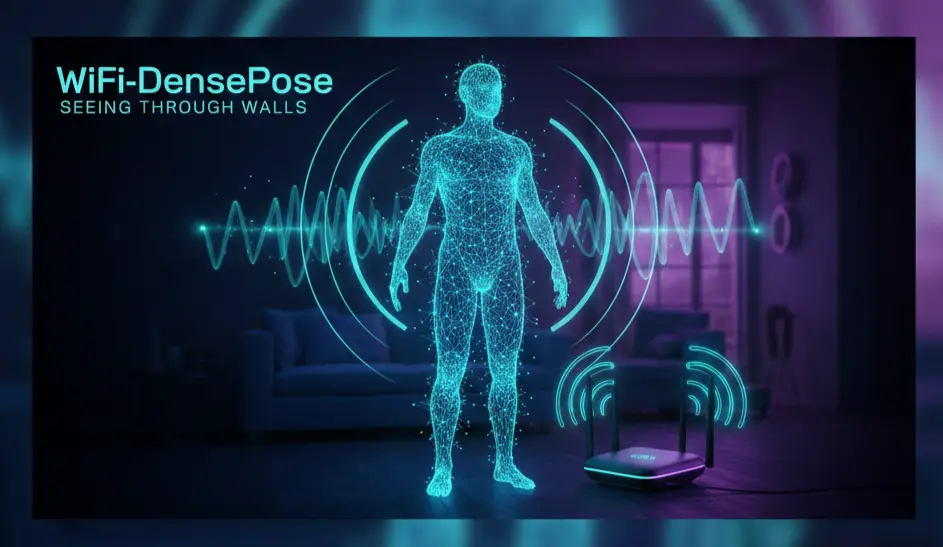
I recently stumbled across WiFi-DensePose, and honestly? It’s one of those projects that is equal parts brilliant and deeply unsettling. If you haven’t been following the niche intersection of signal processing and computer vision, here’s the gist: researchers have figured out how to use ordinary WiFi signals to "see" people through walls, mapping their body posture in 3D real-time.
Yeah. Read that again.
What are we actually looking at?
Normally, if you want to track a human body’s pose, you use a camera and something like Facebook’s DensePose, which maps pixels to a 3D surface of the human body. It’s impressive, but it requires line-of-sight. If there’s a wall, a curtain, or total darkness, the camera is useless.
WiFi-DensePose throws the camera out the window. Instead, it uses the CSI (Channel State Information) from standard WiFi routers. Think of it like this: every time you move, you’re slightly distorting the invisible web of radio waves filling your room. This project uses a deep neural network to interpret those distortions and translate them into a high-fidelity, 3D "mesh" of your body.
It’s not just a blurry blob, either. It’s identifying your limbs, your torso, and how you’re oriented in space.
The "Wait, Really?" Factor
I’ll admit, when I first saw the demos, I looked at my own router with a bit of side-eye. We’ve spent years worrying about our webcams being hacked, but we never really considered that the very signal providing us with Netflix could be used to silhouette us while we’re pacing in our pajamas.
But from a technical standpoint? It’s a masterclass in "making do" with noisy data. WiFi signals are messy. They bounce off refrigerators, get absorbed by water tanks, and scatter off couches. The fact that the team behind this (and the foundational researchers at CMU) managed to clean that signal enough to feed it into a modified DensePose architecture is... well, it’s kind of a miracle.
Why this matters (The Good and the Bad)
I know where your head is going, privacy. And you’re right to be concerned. This tech effectively turns every cheap router into a low-resolution radar. The potential for non-consensual surveillance is high, and let’s be real, the "creepy factor" is off the charts.
However, if we put the dystopia aside for a second, the practical applications are actually pretty noble:
- Elderly Care: Monitoring for falls in a home without putting invasive cameras in bathrooms or bedrooms.
- Search and Rescue: Finding victims in smoke-filled buildings where thermal or standard imaging fails.
- Home Security: Detecting an intruder's presence and movement patterns without needing light.
Final Thoughts
The project on GitHub is a fascinating look into how the physical and digital worlds are blurring. It’s a reminder that "privacy" is becoming a very fluid concept. We used to think walls were the ultimate boundary; WiFi-DensePose proves they’re just another medium for data to pass through.
Is it cool? Absolutely. Is it a bit terrifying? You bet. But if you’re a dev or a tech enthusiast, you should definitely clone the repo and poke around. Just maybe... don’t think too hard about it the next time you’re walking past your router.
Check it out here: ruvnet/wifi-densepose
Inspire Others – Share Now
Agentic AI Saksham
India’s Only 1st Ever Offline Hands-on program that adds 4 Global Certificates while making you a real engineer who has built their own AI Agents
EV
Saksham
India’s Only 1st Ever Offline Hands-on program that adds 4 Global Certificates while making you a real engineer who has built their own vehicle
Agentic AI LeadCamp
From AI User to AI Agent Builder — Capabl empowers non-coding professionals to ride the AI wave in just 4 days.
Agentic AI MasterCamp
A complete deployment ready program for Developers, Freelancers & Product Managers to be Agentic AI professionals